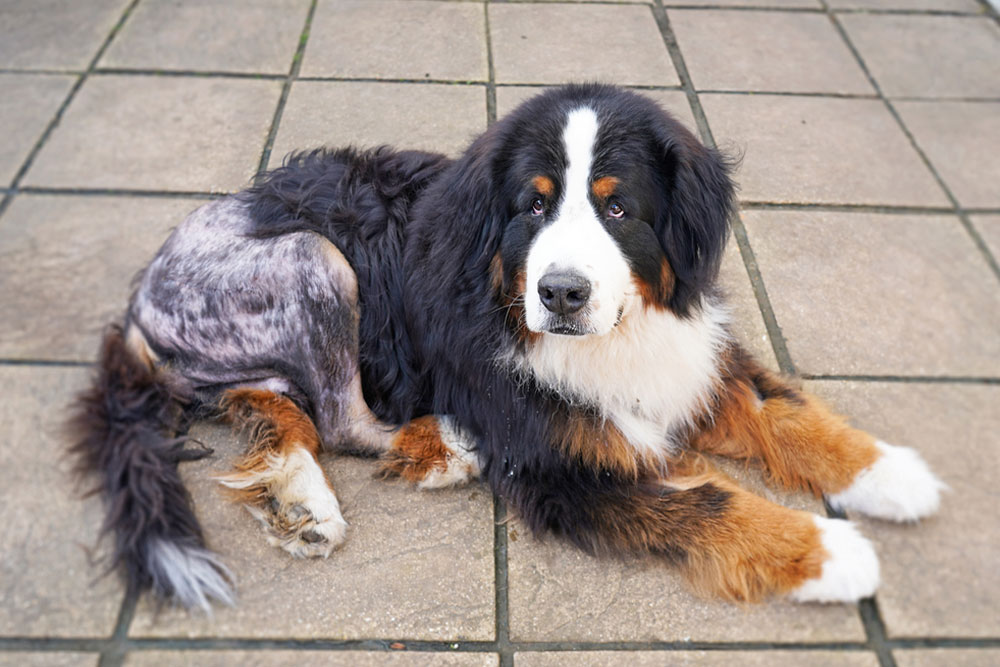
A dog healing from surgery for a torn cranial cruciate ligament (CCL), the canine version of an ACL tear, usually touches the toe down within the first couple of weeks, walks steadily by about week eight, and is cleared for real activity in the four-to-six-month range. The stretch in between is where families feel unprepared, because a dog who feels better than his knee actually is still has to be kept quiet. The pace depends on which repair was done and how closely rehab is followed, and most setbacks happen when a good-feeling dog does too much too soon.
Recovery is where The Animal Clinic of Council Bluffs does some of its most careful work: recheck exams to catch trouble early and digital X-rays to confirm the bone is healing after an osteotomy-based repair. When a mending knee needs extra support, we offer PRP (platelet-rich plasma) and stem cell therapy, regenerative treatments prepared from your dog’s own cells to quiet inflammation and support healing. Caring for your dog like our own means straight answers through the healing months: what each week should look like, what counts as normal soreness, and which changes mean the knee needs a recheck. When the discharge folder feels like too much, request an appointment at either our Council Bluffs or Glenwood office and we will turn it into a week-by-week plan you can follow.
Start Here: What Recovery Really Asks of You
- Most dogs are bearing real weight on the leg by around week eight and cleared for normal activity somewhere in the four-to-six-month range.
- The hardest part is not the surgery, it’s keeping a dog quiet during the weeks when he already feels good enough to run.
- A torn cruciate doesn’t heal on its own, and a knee left unstable keeps grinding, building arthritis, and putting the opposite leg at risk of tearing too.
- Rechecks matter, because a repair that’s drifting off course shows up on an exam or an X-ray long before it shows up as a limp you’d notice.
Why Do So Many Dogs Blow Out a Knee Without a Single Bad Step?
The cranial cruciate ligament is a band of tissue deep inside the stifle, the knee joint of the hind leg. Its job is to keep the shin bone from sliding forward out from under the thigh bone each time your dog pushes off. When it fails, the two bones grind together and the knee turns painfully unstable. In dogs, this almost never happens the way a human athlete tears an ACL.
Most cases of cruciate ligament injury in dogs trace back to a ligament that weakened gradually over months, which is why a knee can give out during something as ordinary as hopping off the couch. Because degeneration is the real driver, certain dogs carry more risk:
- Body weight: Every extra pound loads the knee harder. It’s one of the few risk factors fully in your hands, and worth raising at routine wellness visits.
- Breed and build: Labs, Rottweilers, Newfoundlands, and other large, powerfully built breeds are overrepresented, though small dogs are far from immune.
- Knee anatomy: The top of the shin bone is naturally sloped in dogs, and a steeper slope loads the ligament harder, which is why one main surgery works by changing that angle.
- Activity pattern: The weekend warrior, quiet all week then sprinting flat-out on Saturday, stresses a degenerating ligament in bursts it isn’t conditioned for.
Worth planning around: when one CCL tears, the odds the other knee tears within a year or two climb sharply, because whatever weakened the first ligament is usually at work in the second.
How Do You Confirm It’s the Cruciate and Not Something Else?
Confirming a CCL tear comes down to a skilled orthopedic exam paired with imaging. Before that, the tells families notice are a hind-leg limp that comes and goes with activity, hesitation at stairs and the car, a firm thickening on the inside of the knee, and a dog who sits with the sore leg kicked out to the side instead of tucked underneath.
- The hands-on exam: We check for abnormal forward movement of the shin bone with tests like the cranial drawer and tibial thrust, and that laxity is the hallmark of a torn cruciate. Anxious dogs sometimes need light sedation so the knee can relax enough to give an honest answer.
- Radiographs: X-rays reveal how much arthritis has taken hold, rule out other causes of hind-leg lameness, and give the surgeon the measurements needed for planning.
- Advanced imaging when needed: When a tear is partial or a torn meniscus is suspected, MRI captures soft-tissue detail radiographs can’t show. It’s reserved for complex cases, and we’ll point you to where the scan can be done.
Can a Torn Cruciate Heal With Rest Alone?
A torn cranial cruciate doesn’t knit back together the way a strained muscle does, and the knee won’t re-stabilize on its own no matter how much rest it gets. Rest can quiet the soreness for a while, which is exactly why a knee left alone can seem deceptively better right before it flares again. Meanwhile the arthritis that follows an unstable joint only deepens, and that’s only part of what an untreated tear sets in motion:
- A torn meniscus: The meniscus is the cushion inside the knee, and an unstable joint shears it over time, bringing a fresh spike of pain and often a bigger repair later.
- Muscle wasting: A leg the dog stops using loses thigh and hip muscle within weeks, which makes any future surgery harder and recovery slower.
- The other leg pays the price: Dogs shift weight onto the sound hind limb to spare the painful one, which is part of why the opposite cruciate so often tears next.
Waiting usually makes the eventual fix harder, so it’s worth scheduling an evaluation early rather than watching and hoping.
When Is Surgery the Answer, and When Can We Skip It?
The right path depends less on the tear than on the dog attached to it, and much of it is physics. In a very small dog, the forces crossing the knee are low enough that scar tissue and strong muscle can sometimes stabilize it, so conservative management occasionally works. In a fifty- or ninety-pound dog, those same forces overwhelm anything but a mechanical repair, which is why surgery is the consistent recommendation for medium, large, and giant breeds.
Conservative management means strict activity restriction for weeks, anti-inflammatory medication, weight management, and structured physical therapy. It asks a lot of a family and is considered mainly for the smallest patients or those who can’t safely undergo anesthesia. Which path suits your dog is a conversation to have with our veterinarians.
What Are the Surgical Options for Fixing a Torn CCL?
Surgical repairs fall into two families: procedures that change the mechanics of the knee so the joint stays stable without the ligament, and procedures that mimic the ligament with an implant outside the joint. The goal is always a stable, comfortable joint that keeps arthritis to a minimum.
| Repair | How it works | Best suited to |
| TPLO (tibial plateau leveling osteotomy) | The top of the shin bone is cut and rotated to a flatter angle, so the joint no longer needs the ligament to stay stable | Larger, active, and athletic dogs, and many mid-size dogs |
| TTA (tibial tuberosity advancement) | The front of the shin bone is cut and advanced forward, changing the pull of the knee’s tendon to neutralize the same forward slide | Selected dogs, depending on knee geometry and surgeon preference |
| Extracapsular repair (lateral suture) | A strong suture placed outside the joint holds the bones in position while scar tissue builds long-term stability | Smaller and less active dogs, and some medium dogs |
TPLO surgery is usually the first choice for larger, athletic dogs and tends to give the most durable long-term function, while the extracapsular repair holds up well under the lighter loads of a smaller, calmer dog. Whichever approach is chosen, the meniscus gets inspected during the procedure and any torn cartilage is trimmed, since a damaged meniscus left in place is one of the most common reasons a knee stays sore after an otherwise good repair.
Cruciate surgery calls for a surgeon experienced in orthopedics, careful anesthesia monitoring, and a real pain-control plan. Our veterinarians will help you understand which repair fits your dog and why, walk you through what the procedure and hospitalization involve, and make sure the plan and your dog’s records are lined up before the day arrives.
What Does Rehab After Cruciate Surgery Involve?
The surgery restores the mechanics. Rehabilitation restores the dog. Skipping or rushing it is one of the most common reasons a good repair underperforms, because a stable knee still needs conditioned muscle and full range of motion to work.
Structured rehabilitation protects the repair while it heals and rebuilds the muscle the leg lost, and it unfolds in stages. The earliest weeks are strict rest and gentle, controlled motion while the bone or scar tissue does its work. As healing is confirmed, activity ramps up in careful steps: slow leash walks stretch a little longer, then gentle inclines, then a gradual return to normal life.
Controlled leash walking, range-of-motion work, and underwater treadmill therapy where available all rebuild strength without overloading the joint, and we’ll send you home with specific exercises to do between rechecks. For a knee that needs extra help settling inflammation, ask us whether PRP or stem cell therapy fits your dog’s recovery plan.
What Does the Recovery Timeline Actually Look Like?
Recovery runs in stages rather than one long stretch, and knowing which stage you’re in is what keeps the pace honest. The table below reflects a typical course. Your dog’s discharge instructions and rechecks always come first, since timelines shift with the repair used, your dog’s size, and how the knee is healing.
| Timeframe | What’s typical | What it asks of you |
| Weeks 1 to 2 | Toe-touching, then light weight on the leg, incision healing | Strict confinement, leash for every bathroom trip, cone on at all times |
| Weeks 3 to 5 | More consistent weight-bearing, soreness easing | Short controlled leash walks as directed, still no stairs or play |
| Weeks 6 to 8 | Walking steadily, recheck X-rays confirm bone healing after an osteotomy | Walks lengthen gradually, still no off-leash running |
| Months 3 to 4 | Muscle rebuilding, gait smoothing out | Structured conditioning, hills and longer walks as cleared |
| Months 4 to 6 | Return to normal activity for most dogs | Gradual reintroduction of running and play |
The number that surprises people is the muscle. A leg that’s been favored for weeks loses noticeable thigh muscle, and rebuilding it is what turns a stable knee into a normal-looking gait. That’s why the last two stages matter as much as the first two.
What Should I Watch For While the Knee Heals?
Most recoveries are uneventful, but a few changes mean the knee needs to be seen rather than watched. Knowing the difference between ordinary post-op soreness and a real problem is what keeps a small issue from becoming a second surgery.
Call us if you notice any of the following:
- Incision trouble. Spreading redness, heat, swelling, discharge, or an edge starting to open. Some bruising and mild swelling in the first few days is normal. Anything worsening after day three is not. Here is a great guide to what’s normal and what’s not at different times in TPLO recovery.
- A sudden return to non-weight-bearing. A dog who was using the leg and abruptly stops needs a look, because that pattern can point to an implant problem or a meniscal tear that showed up after the repair. Here is another great guide to what “normal” leg usage looks like at different points in the healing process.
- A soft swelling that appears days later. Fluid can collect under the incision, and while some of those resolve on their own, we would rather tell you which kind you’re looking at than have you guess.
- Systemic signs. Not eating, lethargy, or fever alongside anything at the surgical site.
- Pain that isn’t controlled. Panting, restlessness, or an inability to settle usually means the medication plan needs adjusting, not that your dog is being dramatic.
The single most-skipped instruction is also the most important one: the cone stays on. A dog can open an incision with about four seconds of determined licking, and a surgical site infection turns a routine recovery into a long, expensive one. If your dog genuinely can’t tolerate the plastic cone, ask us about alternatives rather than going without. The Lick Sleeve can be a good alternative for pets who can’t handle a cone, or who can get around their cone and still reach the incision.
How Do I Actually Keep My Dog Calm and Comfortable at Home?
Home care during cruciate recovery lives or dies on one thing: keeping an energetic dog quiet long enough for the knee to heal. Most setbacks trace back to one enthusiastic leap, a slip on a slick floor, or a patch of ice on a Council Bluffs walkway in January.
Surviving Crate Rest Without Losing Your Mind
For most families the toughest stretch is crate rest, the early weeks of strictly limited movement while the repair is at its most fragile. A healing dog is often a bored, restless one, and that’s where good intentions fall apart. A few things make the stretch more bearable:
- Keep the crate where the family is: A dog resting in the middle of the living room stays calmer than one shut away in a back bedroom.
- Feed the brain instead of the legs: Food puzzles, stuffed and frozen chew toys, snuffle mats, and slow-feeder bowls tire a dog out mentally without a single jump.
- Build a predictable routine: Same short leash trips to the yard, same rest blocks, same quiet evenings. Predictability lowers the anxiety that makes a dog fidgety.
- Leash everything, even the backyard: Bathroom breaks stay on a short leash so a squirrel or a doorbell can’t turn into a sprint.
Protecting the Knee for the Long Haul
Once the early restrictions ease, the goal shifts from strict rest to smart, gradual activity that keeps the knee, and the whole dog, sound for years.
- Ease into and out of movement: Short warm-ups and cooldowns loosen the joint before exertion and settle it afterward, the same way they spare a human runner’s knees.
- Manage the surfaces at home: Runners and rugs over hardwood and tile give a healing dog traction, and blocking access to the couch or bed removes the temptation to leap down onto a mending knee.
- Keep the weight off: Every extra pound multiplies the force crossing the knee, so weight control is one of the most direct ways to protect the repaired joint and spare the opposite leg.
- Skip the high-impact exercise: Jumping for a frisbee, tearing after a ball, and skidding stops are exactly the loads a cruciate hates. Swap them for steady leash walks and controlled play as your dog is cleared.
Track how your dog is doing week to week and adjust with us rather than on a hunch. When you’re ready to set a target weight and conditioning plan, reach out and we’ll build one that fits your dog’s stage of recovery.
Cruciate Injury Questions Pet Families Ask Us Most
Will my dog need surgery on the other knee too?
There’s a real chance, though not a certainty. The best insurance is keeping your dog lean, easing them back into activity gradually, and coming in promptly if that second leg starts to limp.
How soon after the injury should surgery happen?
Sooner is generally better, because a knee left unstable keeps building arthritis and losing muscle, both of which make surgery and recovery harder. That said, cruciate surgery is planned, not an overnight emergency, so there’s usually time to confirm the diagnosis, control pain, and choose the right repair without rushing.
Is my dog too old for cruciate surgery?
Age alone rarely rules it out. What matters far more is overall health, and a comfortable, active senior with good bloodwork often does beautifully. Before any procedure, pre-anesthetic testing and a thorough exam help us weigh the risks for your individual dog, and for some older patients a conservative plan may be the kinder choice. It’s a decision we make together, putting your dog’s comfort and quality of life above a number on the chart.
My dog was doing great and suddenly stopped using the leg. What happened?
This is worth a same-day call rather than a wait. Sometimes it’s a simple flare after too much activity, but a sudden step backward can also mean a meniscal tear that developed after the repair or a problem with the implant. Both are far easier to address early, and an exam plus X-rays usually tells us quickly which one we’re dealing with.
Giving Your Dog a Comfortable, Active Life After a Cruciate Tear
A torn cruciate can feel like a huge diagnosis, but the outlook is good when the limp is caught early, the repair fits the dog, and the rehab is followed through. The lean-body, safe-surface, gradual-activity habits that protect the repaired knee are the same ones that guard the other, and periodic rechecks let us monitor the joint as your dog ages.
You don’t have to figure any of this out alone. When you’re ready to talk through your dog’s knee and map out the next step, book an orthopedic evaluation at The Animal Clinic of Council Bluffs or our Glenwood office and we’ll help you build a plan you can live with.